 By
By Anyone with more than one child knows the particular flavour of backyard argument that has nothing to do with sharing toys and everything to do with age gaps. The six-year-old wants to use the equipment the way it’s meant to be used; the three-year-old wants to do exactly what the six-year-old is doing, right now, regardless of whether they’re physically ready for it. The result is a familiar cycle of tears, “it’s not fair,” and a parent playing referee instead of getting five quiet minutes to drink a coffee while the kids play.
The instinctive fix — buying separate, age-specific equipment for each child — gets expensive fast and rarely solves the actual problem, since kids this age want to play together, not in parallel isolation. The better solution is choosing equipment genuinely designed to work across a spread of ages at once, so siblings can share a space without one of them being constantly told to wait, watch, or move aside.
Why Age Gaps Cause More Backyard Conflict Than Anything Else
Most backyard equipment is designed with a fairly narrow age band in mind, which works fine for an only child but creates friction the moment a sibling of a different age enters the picture. A slide pitched perfectly for a five-year-old might be genuinely unsafe for a two-year-old attempting it unsupervised, while a climbing structure scaled for a two-year-old offers no challenge at all to an eight-year-old — and eight-year-olds tend to make that boredom known, loudly, in ways that escalate quickly into arguments.
The equipment itself isn’t the enemy here; the mismatch is. Structures designed with a wide, genuine age range in mind — rather than a narrow sweet spot with a token allowance either side — remove a huge amount of the friction before it starts.
Slides That Work for More Than One Age at Once
A slide is often the first flashpoint between siblings, precisely because it looks equally appealing to a toddler and a primary-schooler but suits neither equally well at a single fixed height and pitch. The better approach is choosing a slide system designed around genuine multi-age use — adjustable entry height, a gentler pitch that’s still engaging for older kids, and a platform arrangement that lets a younger sibling watch and wait their turn from a safe, comfortable spot rather than being physically excluded from the area entirely.
Reviewing a proper range of Kids Slides built specifically with this kind of flexibility in mind — rather than a single-height, single-audience design — tends to remove a surprising amount of the “it’s my turn” conflict, simply because the equipment itself accommodates more than one child’s needs at once instead of forcing a choice between them.
Designing the Whole Yard Around Parallel Play
Beyond any single piece of equipment, the way a yard is laid out has a huge influence on sibling harmony. Younger and older children genuinely play differently — different pace, different noise level, different tolerance for waiting a turn — and a yard that forces them into the exact same space at the exact same time will generate friction no matter how good the individual equipment is.
A more effective layout separates, without fully isolating, different play intensities:
- A calmer, imaginative zone — typically a cubby house — where a younger sibling can play at their own pace without needing to keep up physically with an older one
- A moderate-intensity zone — swings, a gentle slide — that both age groups can genuinely enjoy together without one constantly waiting on the other
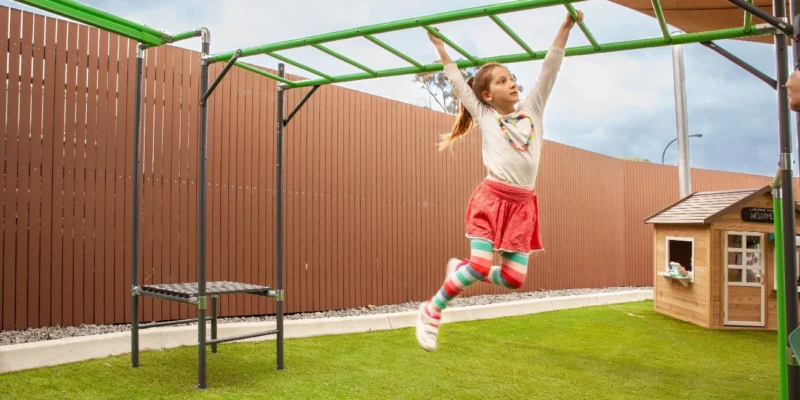
- A higher-intensity zone for older kids — climbing, balance challenges — positioned so a younger sibling can watch safely from a distance without being drawn into something beyond their ability
Browsing a genuinely broad range of outdoor play equipment with this kind of zoning in mind, rather than buying a single item and hoping it suits everyone, tends to produce a far more harmonious yard than a one-size-fits-all approach ever manages.
The Cubby House as Shared Territory, Not Contested Territory
Interestingly, the cubby house tends to be the one piece of equipment that naturally supports multi-age play without much extra planning required. Older kids use it as a clubhouse or social base; younger kids use it as a pretend kitchen or hideout — and because the play styles are compatible rather than competing, siblings of quite different ages often end up sharing a cubby space far more peacefully than they’d share a slide or a swing.
This works best when the structure is genuinely sized for more than one child to use comfortably at once, rather than a compact single-occupant design that turns into its own source of “it’s my turn” conflict. Comparing a solid range of cubby houses for kids with enough internal space for shared, simultaneous use — rather than a design built around a single occupant — tends to sidestep an entire category of sibling argument before it starts.
Setting Ground Rules That Actually Work
Even with well-chosen equipment, a few simple, consistently applied rules make a real difference to how siblings share a space:
- Turn-based rules for genuinely single-user equipment (like a single slide chute), agreed on and enforced consistently rather than negotiated fresh every time
- Clear “supervised only” zones for equipment that’s appropriate for the older child but not yet the younger one, rather than an all-or-nothing approach to yard access
- Designated “together” activities, such as a shared cubby space or a double-wide swing, that both children can genuinely enjoy at the same time rather than in competition
- Rotating “first pick” privileges, so the same sibling isn’t always waiting while the other always goes first
When Equipment Choice Solves the Problem Rules Can’t
It’s worth being honest that no amount of rule-setting fully solves a fundamental mismatch in equipment design. If a structure genuinely only suits one age well, siblings of different ages will keep colliding over it regardless of how fair the turn-taking system is. This is exactly why equipment choice matters as much as parenting strategy here — a well-designed, genuinely multi-age setup removes a category of conflict before any rule needs to be enforced at all.
Conclusion
Sibling conflict over backyard equipment is rarely really about the equipment itself — it’s about a mismatch between what one child needs and what the space actually offers at any given moment. Choosing structures genuinely designed for a wide age range, laying out the yard to separate different play intensities without fully isolating siblings from each other, and setting a few consistent, simple rules together tend to solve far more of the daily friction than most parents expect.
Get the equipment and layout right, and the “it’s my turn” arguments become the exception rather than the daily soundtrack of backyard play.